Scoped API Keys: Securing Your Support Tools with Precision
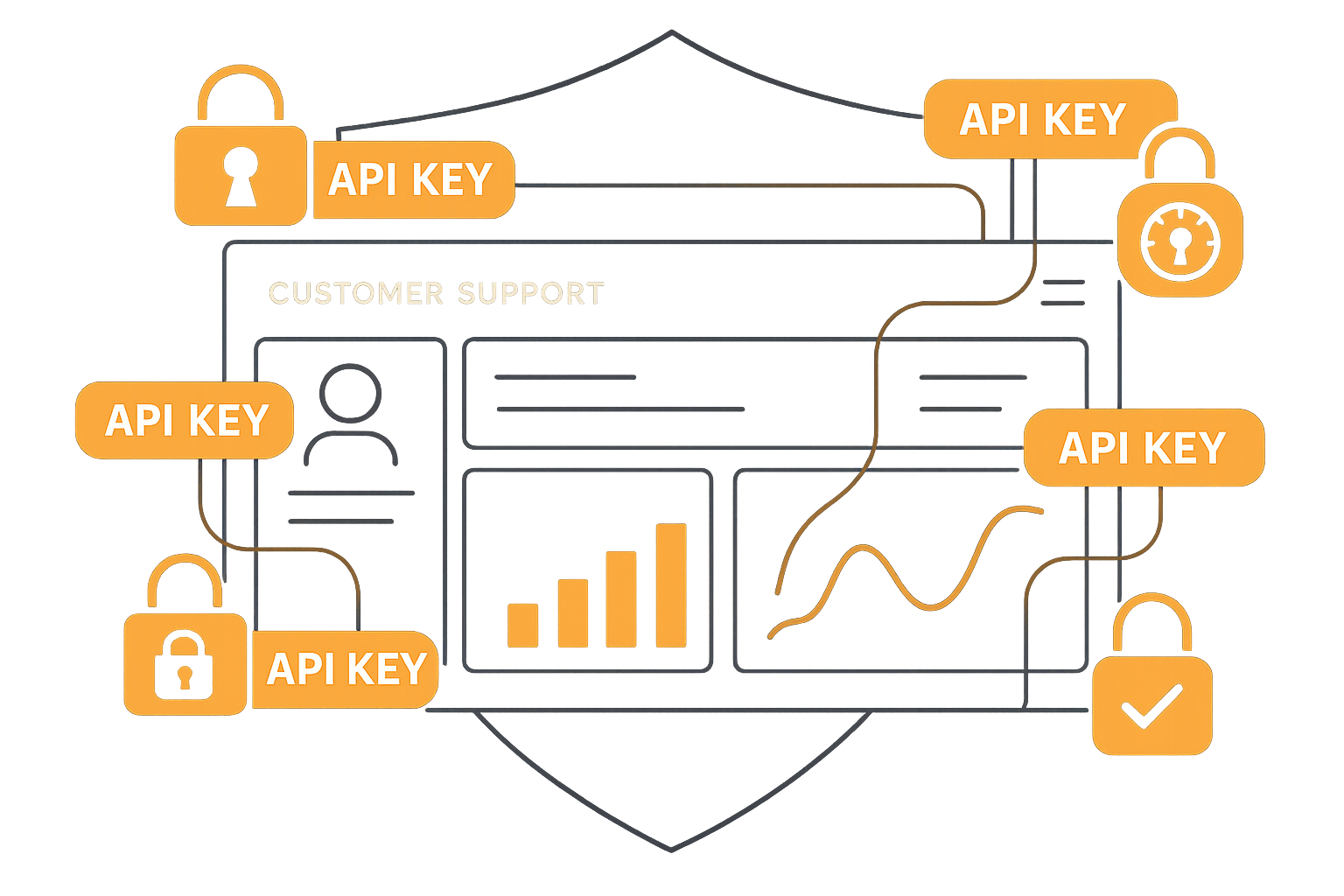
Imagine your support team managing multiple customer inquiries through various tools, each requiring access to sensitive information. Without proper controls, a single compromised API key could expose your entire system. Scoped API keys offer a solution by limiting access precisely to what an individual tool or agent needs, reducing the risk of widespread data breaches. For example, a chatbot handling initial inquiries might only need access to basic customer information, not purchase histories or payment details. This fine-grained access control ensures that even if that key is exposed, the damage is contained.
What Are Scoped API Keys and Why Do They Matter?
Scoped API keys are authorization tokens designed to grant limited and specific access permissions rather than full control. This means that instead of a key opening the door to an entire support platform, it only unlocks particular features or datasets relevant to a single function or user role. In practice, this minimizes the blast radius if a key is leaked or misused. A scoped key might allow read-only access to ticket status but block editing or deletion rights, protecting critical data from unintended changes. This targeted access is crucial when integrating multiple third-party tools with varying trust levels.
For support teams relying on integrated systems, scoped keys ensure that each connection—from chatbots to ticketing systems—operates within its designated boundary. This approach enhances security by enforcing the principle of least privilege, a foundational concept in cybersecurity that restricts system access to only what is necessary. Without scoped keys, all integrations might run with full permissions, increasing vulnerability and complicating compliance with data protection standards. For instance, a billing integration should never have permissions to alter support tickets—scoped keys enforce such separation.
Risks of Overbroad API Keys in Support Environments
When API keys have overly broad permissions, several risks emerge. A compromised key could expose confidential customer data or allow unauthorized actions such as ticket deletion or escalation. Beyond external threats, internal misuse becomes a concern if team members have more access than their roles require. For instance, a junior support agent might inadvertently gain administrative privileges, leading to accidental data exposure or system misconfiguration. Overbroad keys also increase the chance of human error causing damage.
Support environments often juggle sensitive information like personal details, purchase history, or payment data. A leak caused by an unrestricted API key can damage customer trust and lead to compliance violations. Therefore, employing scoped API keys is not just a best practice but a necessity to maintain operational integrity. Additionally, managing broad permissions complicates audits and incident investigations, making it more difficult to pinpoint the source of security events. Scoped keys facilitate clearer accountability by narrowing the scope of each key's actions.
Implementing Scoped API Keys Effectively in Your Support Stack
To harness the benefits of scoped API keys, start by mapping out the specific permissions each support tool or team member requires. Define scopes such as read-only access to customer profiles or write access to ticket statuses, and assign keys accordingly. Regularly audit these permissions to ensure they align with evolving roles and functions. For example, if a new integration is added to automate responses, it should receive a key scoped explicitly to the minimal data it needs to operate. This specificity reduces unnecessary exposure and improves operational clarity.
Tools like AItocha CX provide support-centric API key management features that simplify this process. By generating keys with granular scopes, you can maintain strict control while keeping workflows smooth. The key is to balance security with usability so that your team can perform effectively without unnecessary barriers. A common mistake is over-restricting keys, which can cause frequent permission errors and slow down support workflows. Testing scopes in a staging environment helps avoid such pitfalls.
Best Practices for Maintaining Support-Tool Security Details
Beyond scoping, securing API keys involves several best practices. Store keys in encrypted environments, avoid hardcoding them into applications, and rotate them regularly to reduce exposure time. Educate your support team about the importance of safeguarding these credentials and monitoring for suspicious activity. For instance, setting up alerts for multiple failed API authentication attempts can help detect attempted breaches early. Implementing multi-factor authentication where possible adds an extra layer of protection.
- Use environment variables or secure vaults for key storage
- Implement automated key rotation schedules
- Limit API key distribution to essential personnel and systems
- Monitor access logs for unusual patterns
- Integrate alerts for potential key misuse
Incorporating these measures alongside scoped API keys creates a defense-in-depth strategy. This layered approach minimizes risks and helps ensure that your support tools remain trustworthy and resilient against threats. Remember, an API key is like a password; its security depends on both strong technical controls and user awareness. Regular training and updates about best security practices keep your team vigilant and prepared.
Why Scoped API Keys Are a Cornerstone of AItocha CX Security
AItocha CX is designed with security at its core, offering scoped API keys as a fundamental feature. This allows your team to tailor access precisely, supporting complex workflows without sacrificing data safety. For example, you can create different keys for chatbots, automation scripts, and support agents, each with permissions suited to their specific tasks. This segmentation helps contain risks and simplifies compliance management. Moreover, scoped key usage in AItocha CX is accompanied by audit logs, so you can trace key usage and detect anomalies promptly.
By leveraging scoped API keys, you reduce security risks while empowering your support staff with the tools they need. As support environments become more interconnected, these granular controls will play an increasingly critical role in safeguarding customer trust and operational continuity. Exploring the CX product page will provide you with detailed information on implementing these keys effectively within AItocha's system.