Why Transparent Rating-Based Scoring Improves Your Feedback Analytics
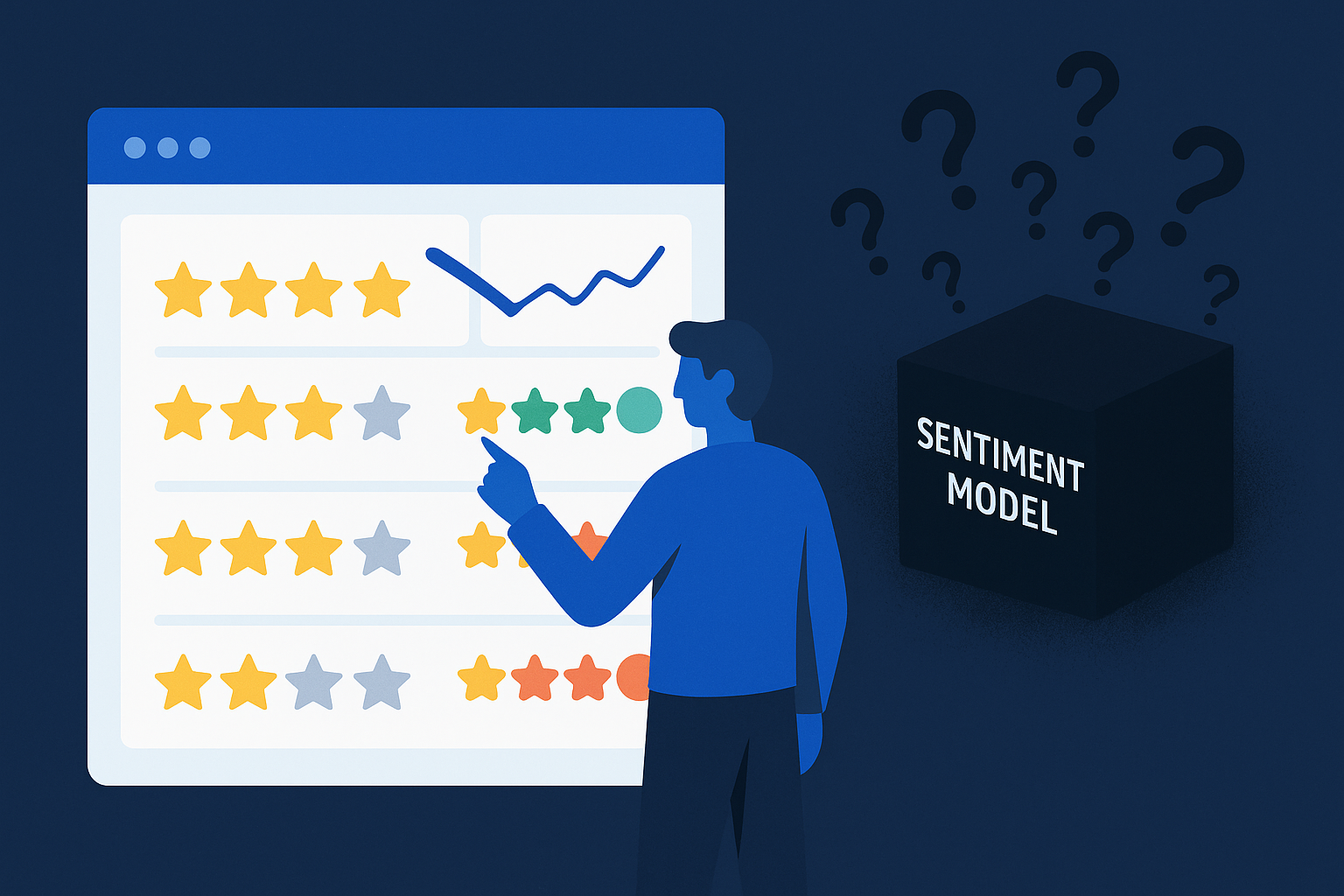
Imagine you’re reviewing customer feedback on your dashboard and see groups labeled simply as “positive” or “negative” with no clear basis for those labels. It leaves you guessing how those sentiments were determined and wondering whether you can rely on this data to make informed decisions. This is a common scenario when using some sentiment models that operate as opaque black boxes. By contrast, AItocha Surveys offers automatic rating-based scoring that uses star ratings or numerical scores to transparently organize feedback. This approach ensures you understand exactly how responses are categorized, making your analytics more actionable and trustworthy.
How Rating-Based Scoring Brings Clarity to Your Dashboard
Rating-based scoring classifies survey responses according to explicit star ratings or numerical scores given by customers, such as 1 to 5 stars. This automatic grouping uses a simple, understandable rule: for example, 4-5 stars indicate positive feedback, 3 stars neutral, and 1-2 stars negative. Unlike sentiment analysis models that interpret text without showing their reasoning, rating-based scoring avoids guesswork. You see exactly why a response is grouped as it is based on the customer’s own score.
This transparency in scoring builds confidence for teams reviewing the data. When insights are linked directly to explicit ratings, you can trust that the grouping reflects customer sentiment as expressed by them, not an algorithm’s hidden logic. Your team can then focus on understanding the feedback details and taking action without second-guessing the scoring method.
For example, if your dashboard shows a cluster of 2-star ratings mentioning delays, it’s clear these responses need operational attention. In contrast, a sentiment model might label some of these comments inconsistently or without clear explanation, leaving you uncertain whether to prioritize them. This concrete linkage between scores and feedback content is what makes rating-based grouping so practical.
Avoiding the Pitfalls of Black-Box Sentiment Models
Sentiment models that operate as black boxes analyze the text responses to assign positive or negative sentiment labels based on complex algorithms. While appealing in theory, these models often leave users in the dark about how scores are derived. The lack of explainability makes it difficult to validate or trust the results, especially when you need to justify decisions based on the feedback.
Furthermore, such models can misinterpret nuances, slang, or context, leading to inaccurate categorizations. When dashboards rely on these opaque assessments, it can cause confusion or even misguide business strategies. Transparent rating-based scoring sidesteps these issues by offering a straightforward, dependable method that your team can easily understand and explain.
Consider a comment containing sarcasm or mixed feelings—sentiment models might misclassify the tone, while rating-based scoring simply reflects the explicit star rating given by the customer. This avoids misinterpretation and ensures that the grouping in your dashboard accurately reflects customer satisfaction levels, not just inferred emotion.
How AItocha Surveys Handles Scoring and Review Requests
AItocha Surveys employs automatic, rating-based scoring exclusively for grouping responses within your analytics dashboard. It never uses these scores to decide who is invited to leave a review. This separation ensures your review collection process complies with policies that require inviting all customers, regardless of rating.
This approach means every respondent who opts in can publicly share their feedback, whether their rating was high or low. Low ratings trigger internal alerts so your team can address issues promptly, but they do not filter or gate review invitations. This practice aligns with Google's policies and FTC guidance, supporting transparency and fairness in feedback collection.
In practice, this means you don’t have to worry about inadvertently excluding dissatisfied customers from review requests, nor about regulatory ramifications from selective solicitation. Instead, you get a complete, honest snapshot of your customer experience, with alerts helping you swiftly respond to problems before they escalate.
Benefits of Transparent Scoring for Your Team and Customers
Using a transparent rating-based system makes it easier for your team to interpret feedback, prioritize responses, and identify trends. Since the scoring is based on explicit customer ratings, there’s no mystery behind grouping, reducing uncertainty and enabling quicker, data-driven decisions.
- Clear rationale for feedback grouping improves trust in analytics.
- Avoids misclassification due to ambiguous sentiment interpretation.
- Supports compliance with policies by not gating review invitations.
- Enables prompt internal response to low scores through alerts.
- Simplifies communication about feedback results across your organization.
- Improves customer trust by openly reflecting all opinions.
- Helps track changes in satisfaction over time using consistent criteria.
For example, your support team can easily identify recurring issues by filtering responses with 1-2 star ratings, then work on those areas to improve service. At the same time, sales or marketing might focus on 4-5 star feedback to highlight strengths in campaigns. Transparent scoring allows each team to engage with the data meaningfully and confidently.
Implementing Transparent Scoring with AItocha Surveys
Getting started with AItocha Surveys takes only a few minutes and provides immediate clarity on how customer feedback is grouped in your analytics dashboard. You can quickly see how rating-based scoring organizes responses so you can focus on improving your customer experience rather than deciphering opaque sentiment labels.
When you activate the system, your dashboard will display feedback grouped by rating categories automatically. This allows you to swiftly spot positive trends or pinpoint problem areas. Additionally, because scoring is transparent and consistent, you can confidently share insights with stakeholders or use the data to guide strategic decisions.
Remember, the power of this system lies in its simplicity and openness. Your team no longer has to question how sentiments were derived or dispute ambiguous categorizations. Instead, everyone understands that the feedback grouping is tied directly to explicit customer ratings, making your analytics more reliable and actionable.