Why Most AI Chatbots Deflect Instead of Resolve — and How to Tell the Difference
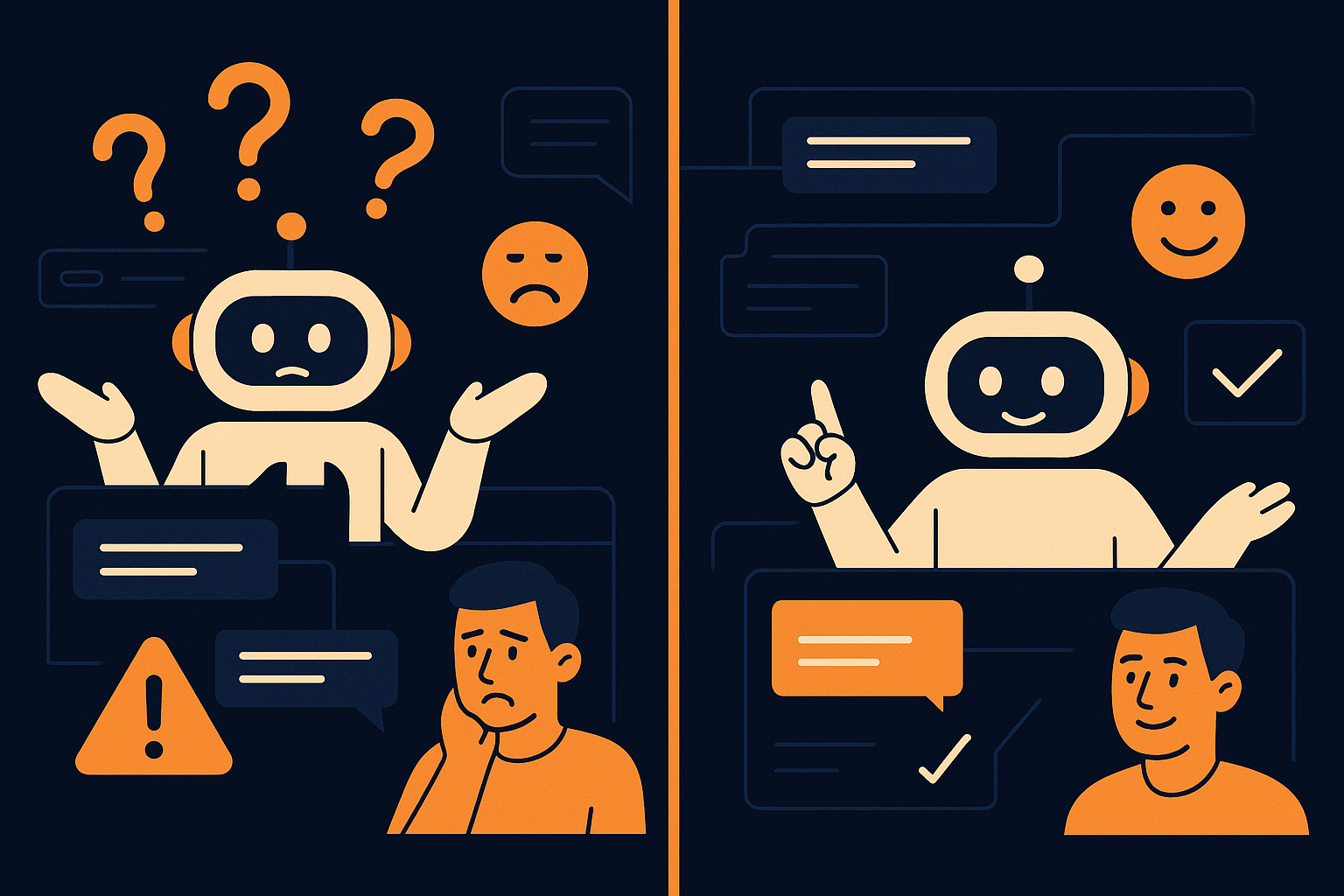
Imagine a customer reaching out for help, only to encounter an AI chatbot that offers vague responses or redirects them to human agents without answering their question. Such experiences highlight a common problem: many AI chatbots deflect rather than resolve inquiries. Understanding why this happens and how to recognize effective AI-powered support solutions can help you improve your customer service outcomes. This issue doesn’t just impact individual exchanges—it can indirectly lower customer retention and increase support costs over time as unresolved issues pile up.
Why AI Chatbots Often Deflect Instead of Resolve
Many AI chatbots struggle to deliver meaningful resolutions because they rely heavily on scripted responses or keyword matching, which limits their understanding of nuanced customer needs. When faced with complex or unexpected queries, these systems tend to defer to human agents rather than attempt resolution. This deflection can frustrate customers who expect quick answers and may lead to longer resolution times for your team.
For example, a customer asking a chatbot about a specific billing discrepancy might receive a generic reply or be passed on without the AI attempting to analyze the issue. This often happens because the chatbot lacks access to the latest account data or the ability to interpret complex questions. The result is a support experience that feels impersonal and inefficient. Often, these AI systems fail to adapt their responses when customers rephrase or clarify their questions, further exacerbating frustration.
Moreover, poor integration with knowledge bases or outdated data can cause AI chatbots to miss available solutions. Without the ability to learn from interactions or access comprehensive information, the chatbot's role becomes primarily triage rather than true problem-solving. The result is a support experience that feels disjointed and inefficient. A chatbot that cannot access current product updates or policy changes may provide incorrect or irrelevant information, prompting unnecessary deflections to human agents.
Recognizing AI Chatbots That Truly Resolve Customer Inquiries
Effective AI chatbots go beyond surface-level interaction; they understand context, retrieve relevant information, and provide accurate answers that resolve most issues automatically. A key indicator of such a system is its ability to close a high percentage of inquiries without human intervention. For example, AItocha CX achieves an 85% automatic resolution rate, meaning most customer requests are handled directly by AI.
You can also tell a resolving chatbot by its smooth handoff process. When an issue requires human attention, the AI smoothly transfers the conversation with all relevant context intact — avoiding repetition and frustration. This efficient collaboration between AI and agents ensures that deflection is minimized and customer problems are genuinely addressed.
In practice, this means customers seldom feel abandoned to a frustrating loop of ‘I don’t understand,’ but instead experience a coherent conversation flow, whether with AI or a human agent. This continuity is key to maintaining trust and satisfaction during support interactions.
Additionally, chatbots designed to resolve often use sentiment analysis to detect customer frustration or confusion, proactively adjusting responses or escalating at the right moment, improving the overall experience.
The Impact of Deflection on Customer Experience and Support Teams
When AI chatbots frequently deflect, customers often face longer wait times and repeated explanations. This leads to dissatisfaction and erodes trust in your brand’s support capabilities. From your team’s perspective, deflection can increase the volume of tickets needing manual handling, negating the intended efficiency gains from AI deployment.
Consider a scenario where a chatbot passes complex inquiries to agents without attempting any resolution. Your support team ends up handling many avoidable tickets, increasing workload and operational costs. This defeats the purpose of AI support and delays response times for everyone.
Moreover, deflection creates a negative feedback loop: frustrated customers may reach out multiple times on the same issue, clogging support channels and lowering agent morale. Over time, this can harm your team’s ability to focus on priority tasks and innovate processes.
Deflection may also mask underlying issues in your knowledge management or training processes, since the AI is unable to access or apply accurate information. Over time, this can result in inconsistent support quality and missed opportunities to automate routine tasks. Addressing deflection is crucial to improving both customer satisfaction and operational costs.
How to Choose AI Chatbots Designed to Resolve, Not Deflect
Selecting an AI chatbot that prioritizes resolution involves evaluating its knowledge integration, natural language understanding, and escalation workflows. Look for systems that continuously learn from interactions and update their responses accordingly. The ability to resolve 85% or more of inquiries automatically is a strong benchmark for effective AI support.
- Integration with up-to-date and comprehensive knowledge bases
- Advanced natural language processing that understands intent and context
- Transparent metrics showing auto-resolution rates and handoff quality
- Customizable workflows that match your team’s needs
- smooth handoff to human agents with full context retention
By focusing on these features, you ensure your AI chatbot serves as a genuine support tool rather than a deflection mechanism. Exploring the capabilities of AItocha CX can help you understand how these elements come together to increase resolution rates and improve customer satisfaction.
Practical Steps to Evaluate and Improve Your AI Chatbot’s Resolution Performance
If your current AI chatbot tends to defer rather than resolve, start by gathering data on its resolution rates and customer satisfaction scores. Analyze common deflection scenarios to identify gaps in knowledge or understanding. From there, enhance your chatbot’s training content and integrate better data sources to improve accuracy.
Regularly monitor conversations to fine-tune the AI’s responses and update workflows for smoother handoffs. This might include adding new intents, refining existing ones, or improving context handling to reduce unnecessary transfers to human agents.
Consider also user feedback loops and internal agent input as valuable sources for improving AI accuracy and relevance. A continuous improvement mindset prevents deflection from becoming the default outcome.
Investing time in these improvements can shift your chatbot from a frustrating gatekeeper to an effective first-line support agent. Imagine the relief for your customers and your team as more inquiries are answered right away, freeing your agents to focus on complex cases that truly require human expertise.