Auto-Resolution Rate as a Support Metric: What 85% Means in Practice
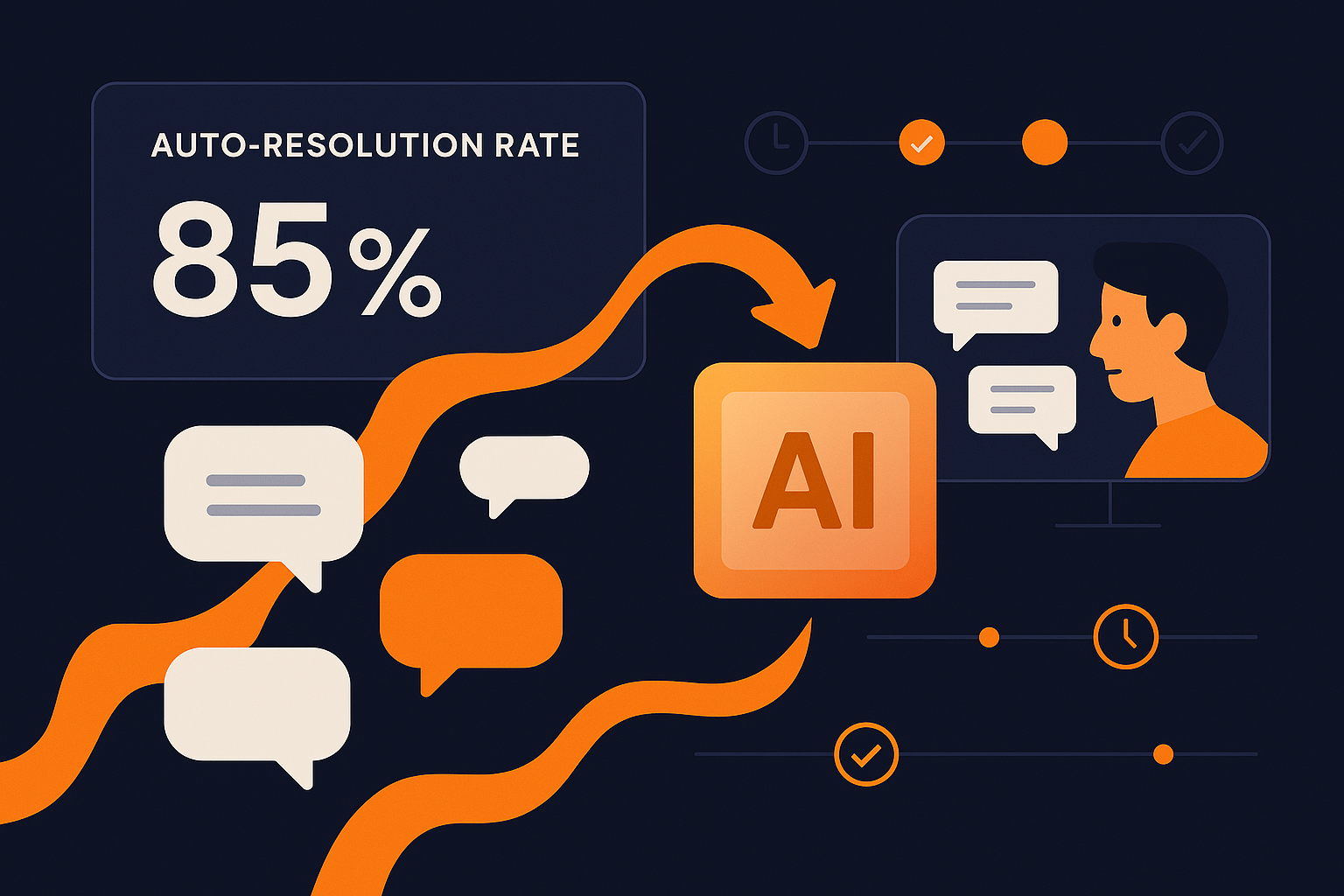
Imagine your customer support team receiving 100 inquiries daily, and 85 of those are resolved without any human intervention. This 85% auto-resolution rate isn't just a number; it's a lens through which you can examine the efficiency and effectiveness of your support operations. Understanding what this metric means in real terms helps you set realistic expectations and optimize your customer service strategies.
Defining Auto-Resolution and Its Impact on Support Efficiency
Auto-resolution refers to the capability of an AI-powered support system to handle customer inquiries completely on its own, without needing to escalate to a human agent. Achieving an 85% auto-resolution rate means that your AI handles the vast majority of questions, freeing your team to focus on more complex or sensitive issues. This shift can lead to faster response times for customers and reduced workload and burnout for human agents. However, it also demands that your AI understands the nuances of your customers’ needs and the specific context of their inquiries.
To put this in perspective, if your team previously spent hours daily answering routine questions—like order status, return policies, or product details—those tasks become largely automated. This allows your human agents to dedicate time to issues that require empathy or problem-solving beyond scripted responses. However, maintaining this balance requires continuous monitoring to ensure the AI stays aligned with evolving customer expectations and product updates, avoiding outdated or incorrect replies that could frustrate users.
A common mistake teams make is to set and forget their AI system after implementation, which can lead to degradation in auto-resolution quality over time. Regular audits and refreshes of the AI’s knowledge base prevent this and sustain that 85% performance level. It’s also beneficial to keep agents involved in feeding real-world cases back into the AI’s training to capture subtleties and edge cases.
Translating 85% Auto-Resolution into Customer Experience Outcomes
An 85% auto-resolution rate implies that most customers get their issues fixed promptly, often within seconds or minutes. This speed positively influences customer satisfaction by reducing wait times and providing immediate answers. For your support team, this means fewer repetitive tasks, allowing agents to engage in more meaningful interactions that require empathy and complex problem-solving skills.
In practice, this can look like a customer using an AI chat widget to quickly check their account balance or track a shipment without waiting in a queue. Meanwhile, your agents can focus on handling a billing dispute or technical troubleshooting that requires nuanced understanding. Yet, it’s important to watch for situations where customers might feel their question wasn’t fully answered—prompt follow-ups or smooth access to human help can mitigate any frustration and keep satisfaction high.
Another practical consideration is the diversity of your customer base. Auto-resolution needs to be sensitive to different communication styles, languages, and accessibility needs. Ensuring your AI can handle these variations effectively contributes to a more inclusive and satisfying customer experience overall.
Operational Considerations When Relying on High Auto-Resolution Rates
Maintaining an 85% auto-resolution rate requires ongoing training and refinement of your AI system. Customer inquiries evolve, and so must your AI’s knowledge base and response capabilities. This demands regular monitoring and updates to ensure the AI remains effective and aligned with your brand voice and policies.
For example, seasonal promotions or changes in shipping policies can shift the types of questions customers ask. Without timely updates, your AI might provide outdated information, undermining trust. Establishing a routine process for updating FAQs and training data, along with tracking AI response accuracy, ensures your system adapts proactively. Additionally, integrating feedback from human agents who handle escalations can highlight gaps or misunderstandings the AI needs to address.
A pitfall to avoid is neglecting the monitoring of unusual spikes in unresolved inquiries, which might indicate emerging issues or AI blind spots. Setting up alert systems for these anomalies allows your team to respond quickly and maintain high auto-resolution performance.
Balancing Automation with Human Touch in Support Interactions
Even with an 85% auto-resolution rate, some inquiries inevitably require human attention. These often involve complex problems, emotional situations, or nuanced requests that AI cannot fully address. Recognizing this balance helps you plan your support team size and training accordingly.
Imagine a scenario where a customer experiences a billing error that the AI cannot resolve because it involves sensitive account details or a unique case. In this situation, the AI should identify the limitation and promptly escalate to a human agent, avoiding unnecessary back-and-forth. Successful support systems ensure these handoffs are smooth, preserving customer trust and satisfaction. Training agents to pick up smoothly where AI leaves off is just as important as optimizing the AI itself.
It’s also worth considering how customers perceive automation. Offering visibility and control—such as the option to request a human agent at any time—helps maintain positive sentiment. Clear communication that AI is handling certain requests builds trust and sets expectations appropriately.
Measuring and Utilizing Auto-Resolution Insights for Continuous Improvement
Tracking an 85% auto-resolution rate provides valuable data for analyzing support trends, common issues, and AI performance. Use this insight to identify gaps in the AI’s knowledge, refine your content, and optimize workflows. This iterative approach ensures your system evolves alongside customer needs.
- Monitor resolution accuracy and customer satisfaction scores
- Regularly update AI knowledge bases with new information
- Train AI models on emerging inquiry types and language variations
- Establish feedback loops between AI and human agents
- Leverage analytics to identify bottlenecks and opportunities
For instance, if you notice a spike in unresolved inquiries about a new product feature, this signals the need to update your AI’s training data promptly. By maintaining a cycle of evaluation and improvement, you keep your auto-resolution rate not just high, but also effective in meeting customer expectations. For more details on implementing these strategies, explore the AItocha CX product page, which offers tools to help you optimize your support automation effectively.